




早前往張家界旅遊,再一次接觸流傳已久的湘(湖南)西傳說,湘西趕屍。
湘西趕屍,也曾是香港電影經常涉及的題材,就是幾個列隊穿着清朝官服的屍體(殭屍),跳着跳着的跟隨一個拿着搖鈴的道士,穿州過省,從外地返回自己的家鄉,湘西。那些會「行走」的屍體,我們也叫作「行屍」。
會考完畢的那年暑假,和幾個同學走到大嶼山的渡假屋來個「畢業營」。
電視播出一個靈異節目,當晚的題材正是湘西趕屍,邀請了臨床心理學家顧修全博士解釋屍體走動的原因。
一位臨床心理學家,我想都是用心理學角度例如幻覺之類的去解釋,誰知他講出的是「靜電」,幾個讀理科的同學隨即「媽」聲四起,物理的知識,我都比他強(至少我肯定靜電造不出這現象)。
直至數十年後的一次湘西旅程,才了解這現象的原因......
「落葉歸根」,是中國人傳統思想。死後,屍體也希望能返回故鄉。
當時(清末),發生一些事情,大量屍體需要運往湘西。
傳統運送屍體的方法,是把屍體放在棺木,二人一前一後抬起棺木運送,一具屍體需要二人運送,對於大量屍體的運送需求,並不合符效率。
於是,運送的人把屍體列隊,用兩條竹枝,從屍體的衣袖把屍體一個個串起來,運送的二人一前一後,前方的拿着搖鈴打訊號帶領行走。
就這樣,兩人可以同時運送多具屍體,合符效益,滿足大量屍體的運送需求。
這樣的運送,都在夜間進行,以避開人群造成恐慌。由於在夜間,視野沒有白天般清楚,從遠看,就是一堆會行走的屍體了。
當然,夜間「行走的屍體」是一種避忌,並不會有人走近觀看去求證甚麼。於是,湘西趕屍就成了民間傳說中的行屍,會行走的殭屍了。
On an earlier trip to Zhangjiajie, I once again encountered the long-circulated legend of western Hunan (Xiangxi): Xiangxi corpse driving.
Xiangxi corpse driving was also a subject often used in Hong Kong films: several corpses in Qing official robes, hopping along behind a Taoist priest holding a bell, crossing provinces and counties to return to their hometown in Xiangxi. Those corpses that could “walk” were also called “walking corpses.”
In the summer after I finished the HKCEE, several classmates and I went to a holiday house on Lantau Island for a “graduation camp.”
A paranormal programme was broadcast on TV that night. The topic was exactly Xiangxi corpse driving, and Dr. John Koo, a clinical psychologist, was invited to explain why corpses could move.
A clinical psychologist, I thought, would surely explain it from a psychological angle—hallucination, for example. But what he said was “static electricity.” Several classmates who studied science immediately erupted in a chorus of “Ma!”—my physics knowledge was stronger than his (at least I was sure static electricity could not produce this phenomenon).
It was not until a trip to Xiangxi decades later that I understood the reason for this phenomenon...
“Fallen leaves return to their roots” is a traditional Chinese belief. After death, people also hope that their bodies can return to their hometown.
At the time (late Qing), something happened that created a need to transport a large number of corpses to Xiangxi.
The traditional method of transporting a corpse was to put it in a coffin and have two people carry the coffin, one in front and one behind. One corpse required two carriers, which was not efficient for the demand of transporting large numbers of corpses.
So the carriers lined the corpses up in a row, used two bamboo poles, and threaded the corpses one by one through their sleeves. Two carriers, one in front and one behind, would transport them; the person in front held a bell and rang it as a signal to lead the way.
In this way, two people could transport several corpses at the same time. It was efficient and met the demand for transporting large numbers of corpses.
Such transport was all carried out at night, to avoid causing panic among crowds. Because it was night, visibility was not as clear as in daytime; seen from afar, it looked like a bunch of walking corpses.
Of course, “walking corpses” at night was a taboo, and no one would go close to watch and verify anything. Thus, Xiangxi corpse driving became the walking corpse in folk legend—a jiangshi, a walking zombie.


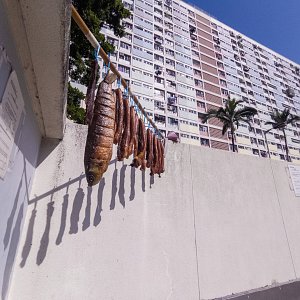
照片為《魁力湘西》旅遊文藝表演中拍攝
Photos taken during the tourism cultural performance The Charm of Xiangxi.